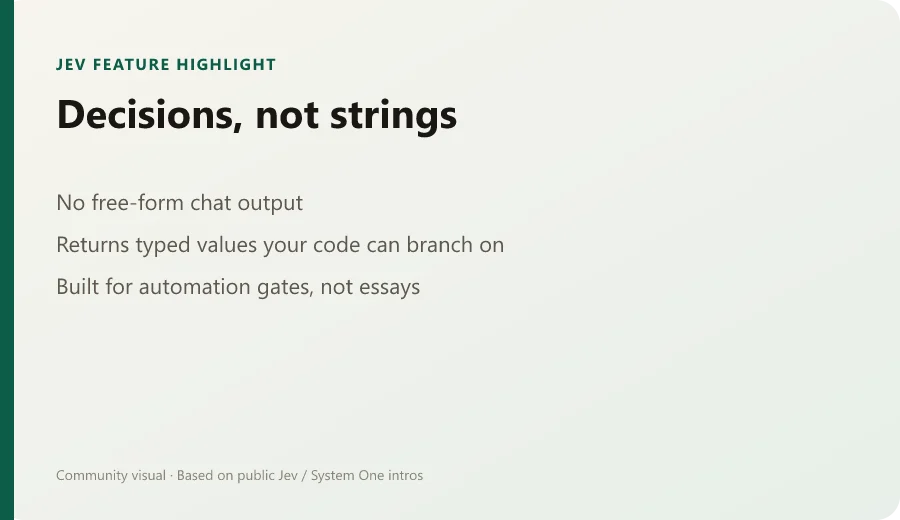
Decisions, not strings
Jev does not write chat replies. It returns typed decisions your agent code can execute directly — the core slogan in every public intro.
System One decision model
Developer guide
Jev is the System One decision model introduced by TypeSafe AI. It is designed for AI agent pipelines where predictable, consistent decisions matter more than creative text generation. The core design philosophy is simple: Decisions not strings.
General-purpose large language models are optimized for writing, reasoning and natural conversation. They are powerful, but their outputs can be unpredictable when used inside automated agent workflows. Jev solves this gap by delivering structured, repeatable decision results.
Visual cards summarizing the talking points that show up again and again in public Jev intros: decisions instead of chat text, smart if-style routing, Choice / Score / Noul, parallel questions, calibrated confidence, schema-safe outputs, and real-time friendly latency. Rewritten for this community site — not a transcript of any single video.
Jev does not write chat replies. It returns typed decisions your agent code can execute directly — the core slogan in every public intro.
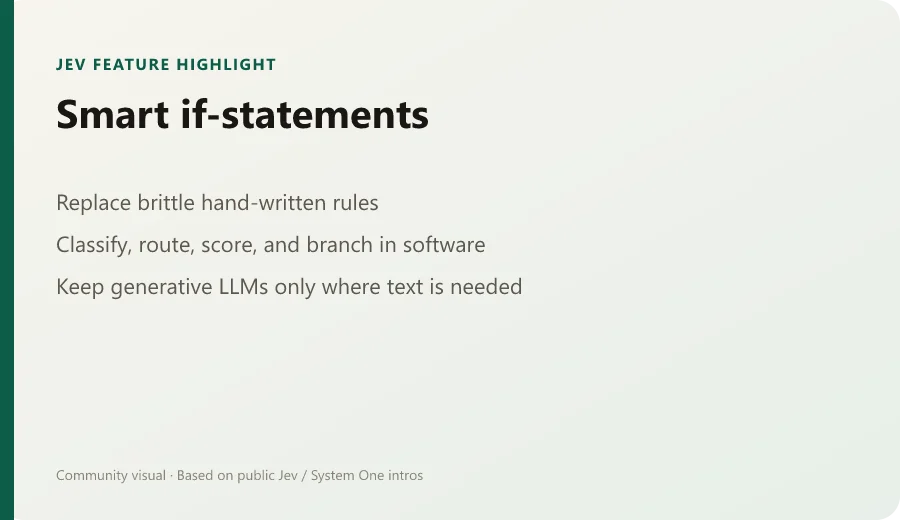
Think of Jev as a fuzzy decision gate inside software: classify, route, score, and branch where hand-written rules are too brittle.
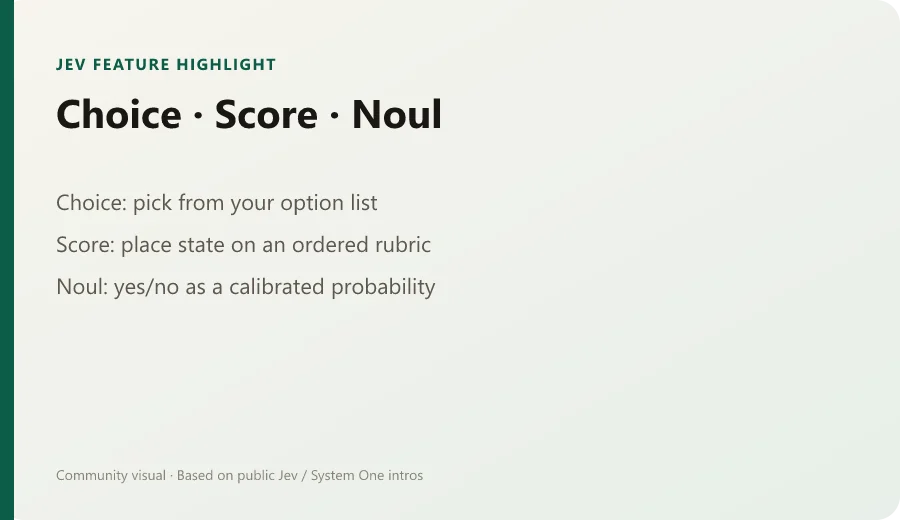
Three primitives cover most automation needs: pick an option, place on a rubric, or answer yes/no with a probability.
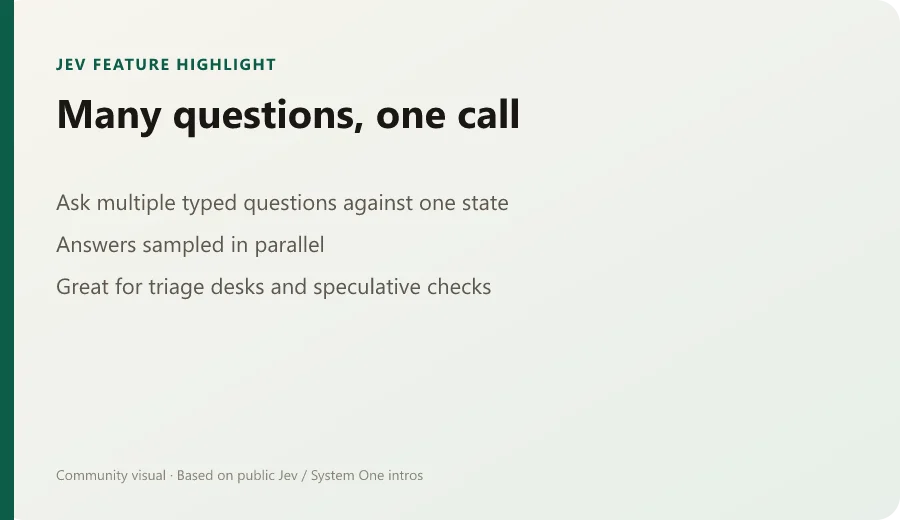
Send one state and several typed questions together. Parallel sampling keeps multi-check triage desks fast.
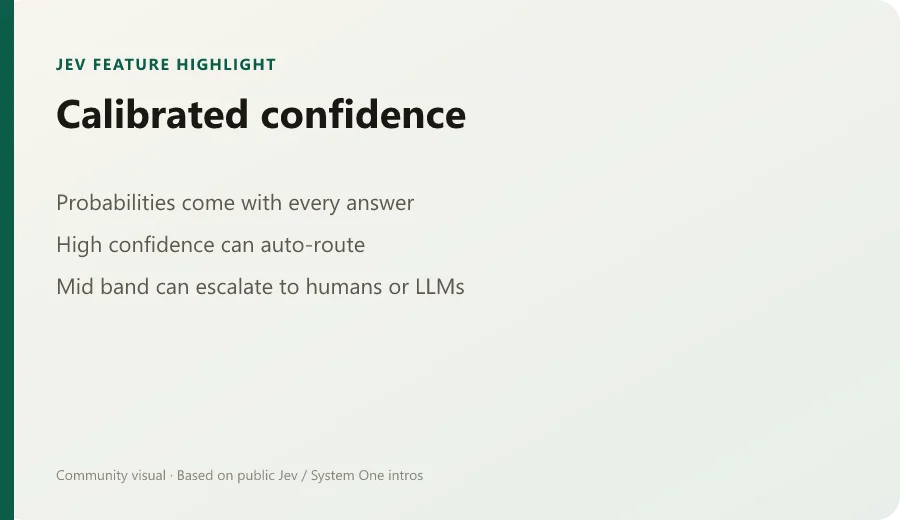
Use high confidence for auto-routing, mid confidence for human or LLM escalation, and keep uncertainty visible in logs.
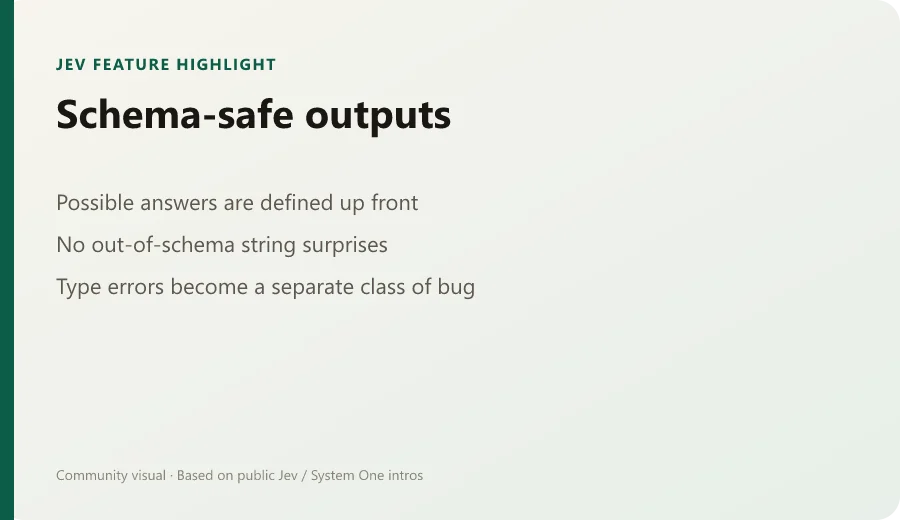
Possible answers are defined up front, so successful responses stay inside your schema instead of inventing free-text labels.
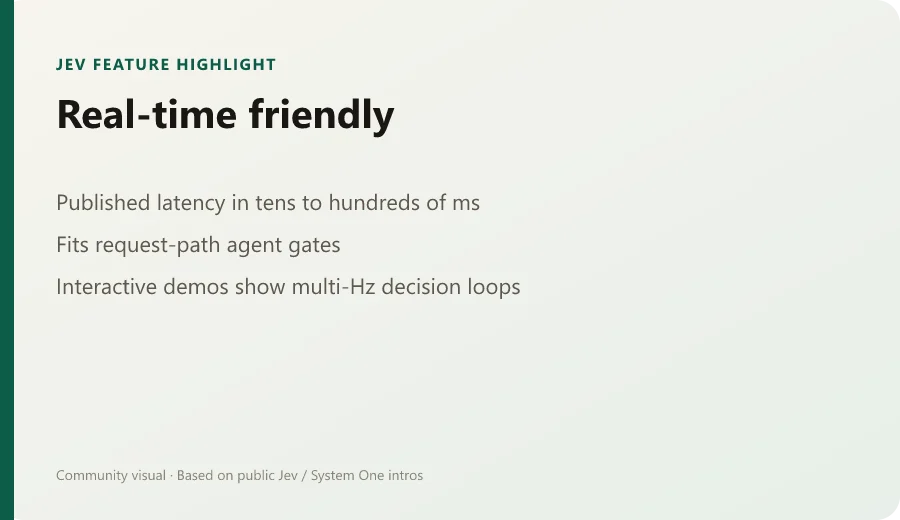
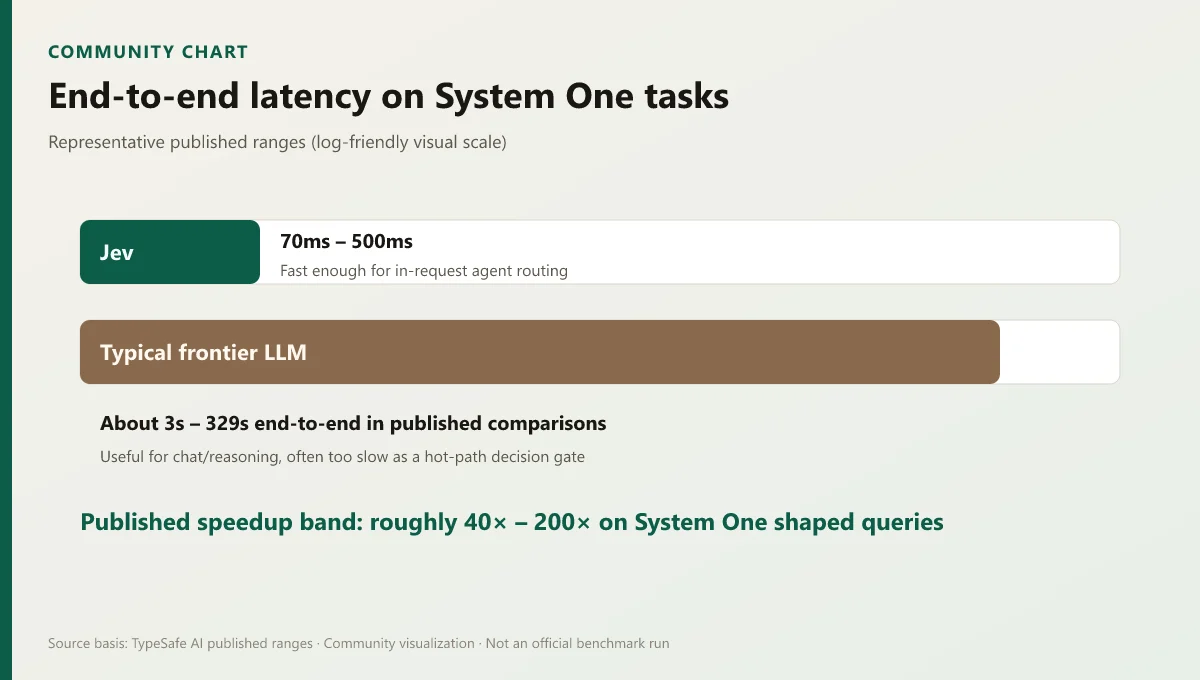
Published latency stays in tens to hundreds of milliseconds — close to request-path and interactive demo budgets.
Charts based on published TypeSafe ranges. Full report with methodology and scenario templates lives on the benchmarks page.
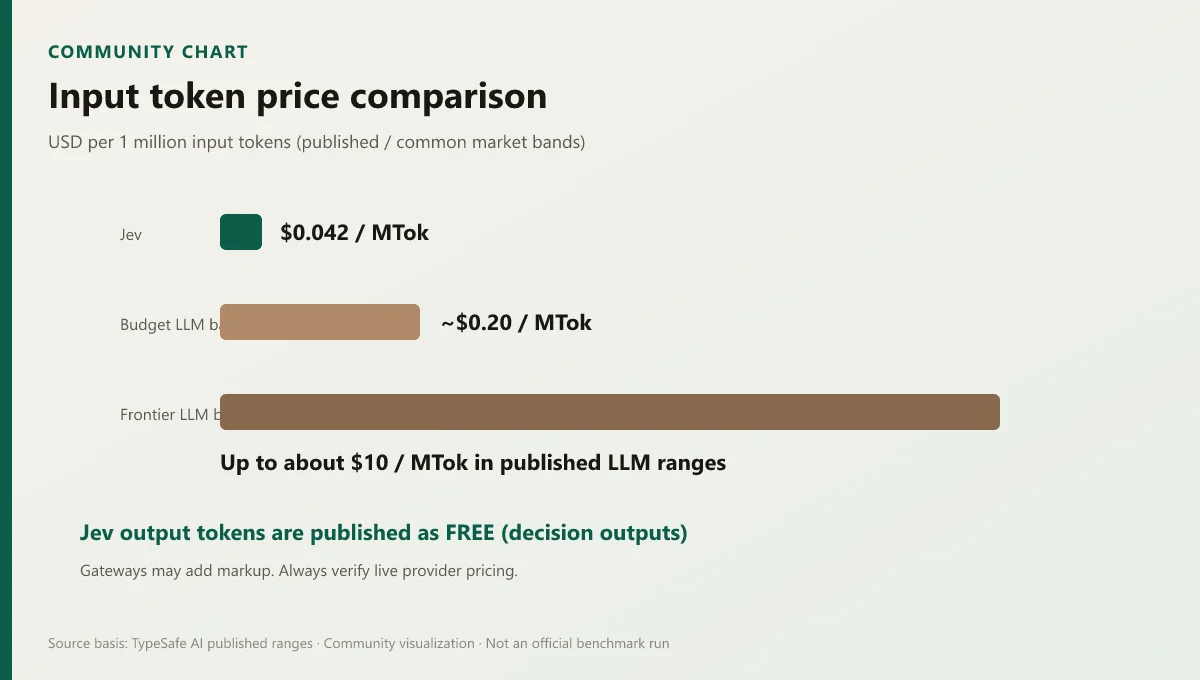
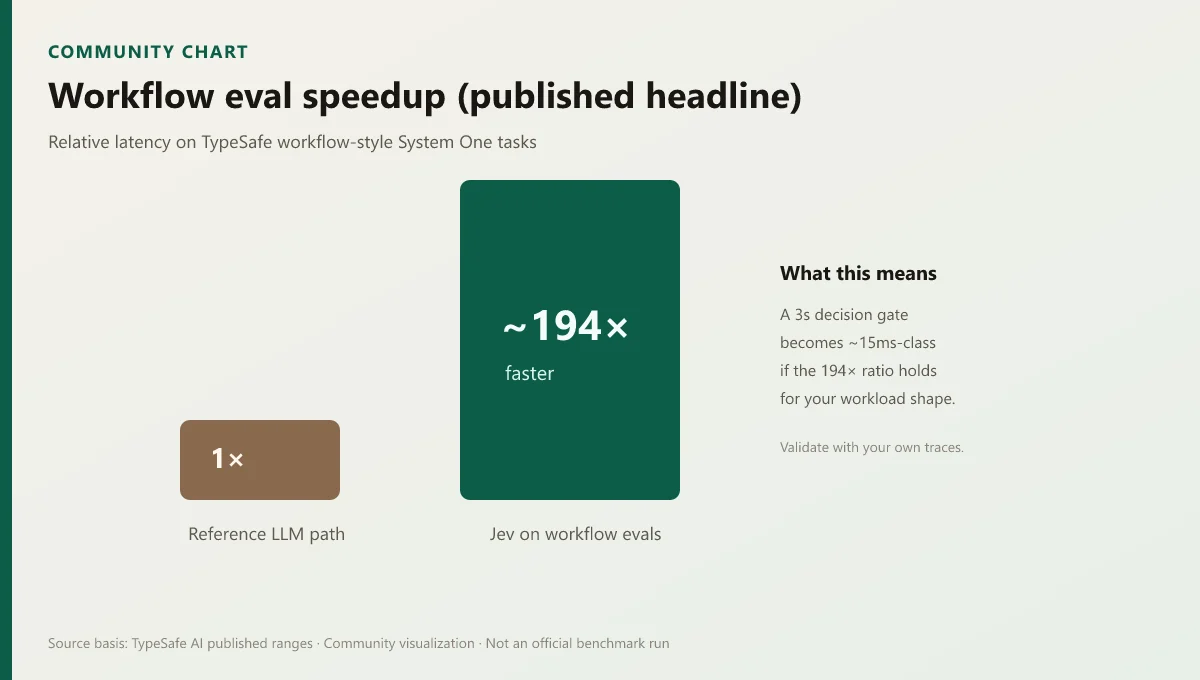
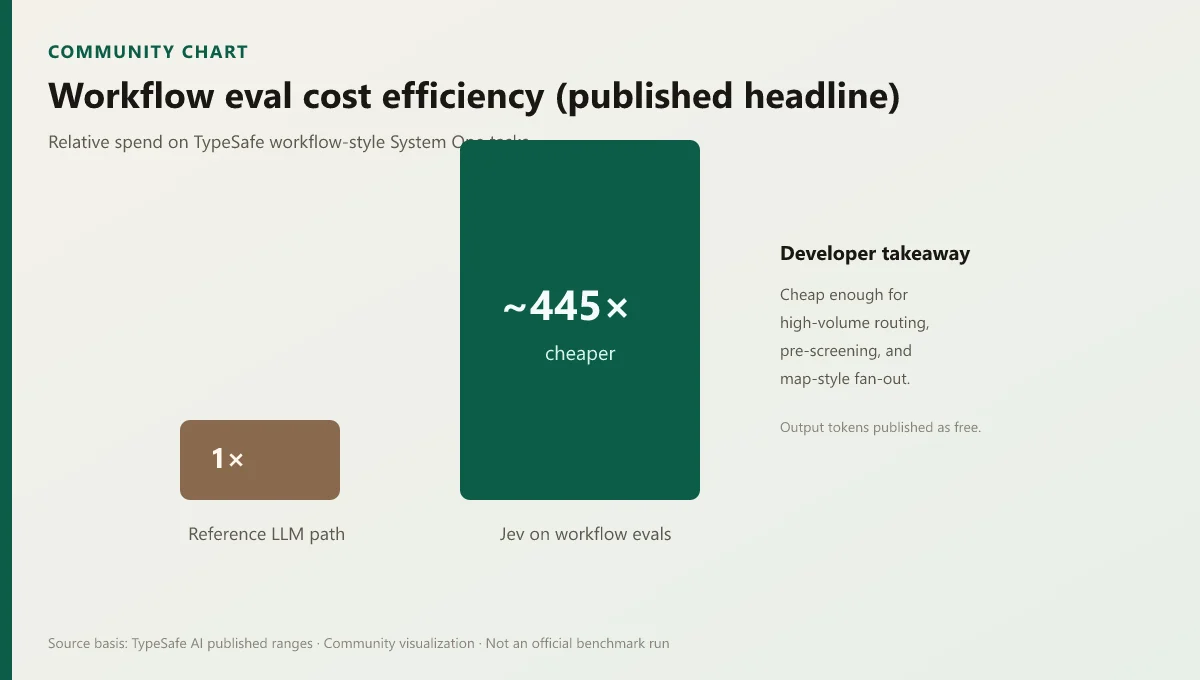
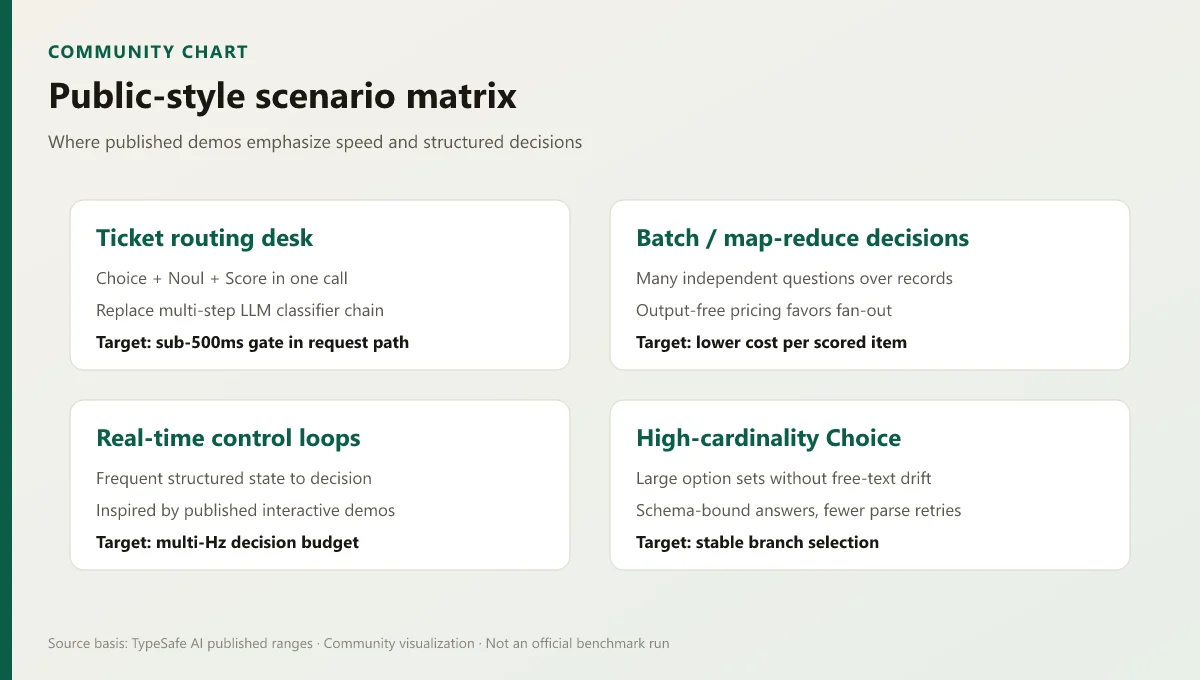
The System One / System Two naming comes from behavioral psychology. In agent engineering terms, the split maps cleanly to two different jobs inside one pipeline. See the glossary for short definitions.
Production stacks rarely pick only one. Most teams put Jev at the decision edge, then call a generative model only when the chosen path needs prose, tool planning, or deeper reasoning. Read the comparison page for a feature-by-feature breakdown.
Jev reduces unpredictable free-text outputs from general LLMs inside agent pipelines, delivering consistent structured decisions.
Product claims and brand assets belong to TypeSafe AI. Start with the official announcement, or read an independent launch summary on Truescho.