Visual report
Jev Speed & Cost Benchmarks
How to read these charts
These are community visualizations built from publicly discussed TypeSafe ranges and workflow headlines. They are not independent lab runs by jevtypesafe.org. Use them to understand order-of-magnitude claims, then verify with your own fixtures through the API guide.
- Latency bands matter most for in-request routing gates.
- Input price + free outputs matter most for high-volume scoring.
- Workflow multipliers are workload-dependent; treat them as upper-band marketing evidence.
Latency chart
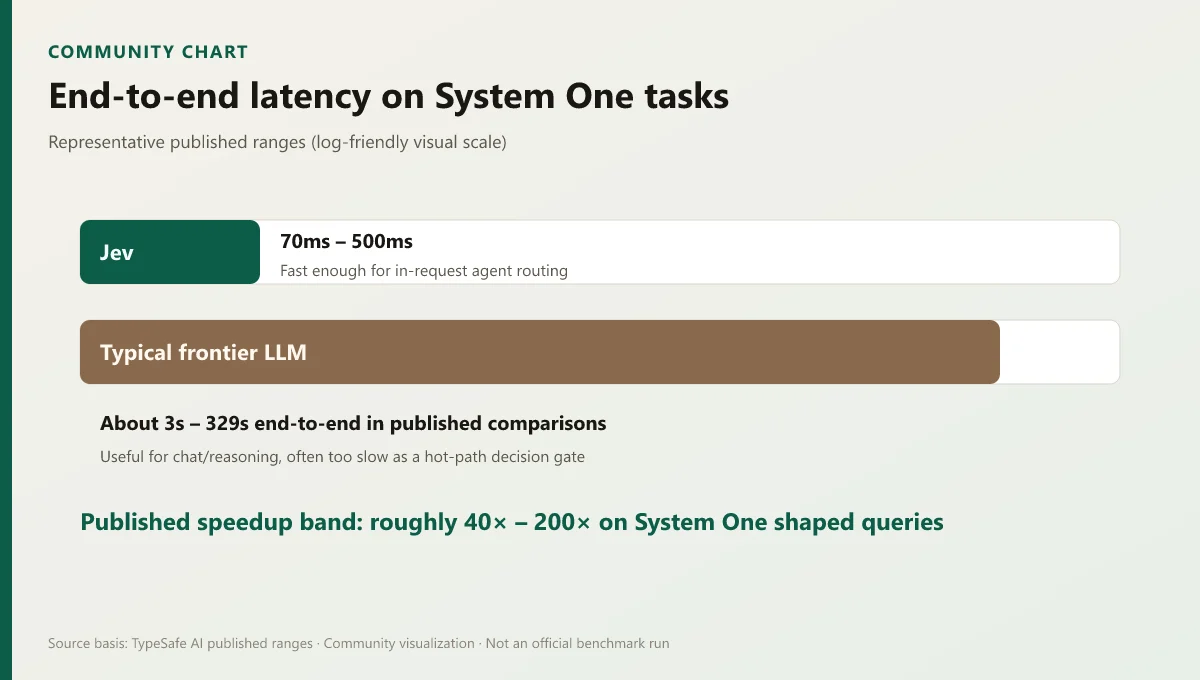
Generative frontier models can take seconds to minutes end-to-end. Jev's published System One band is tens to hundreds of milliseconds — the difference between a snappy agent gate and a blocked request.
Pricing chart
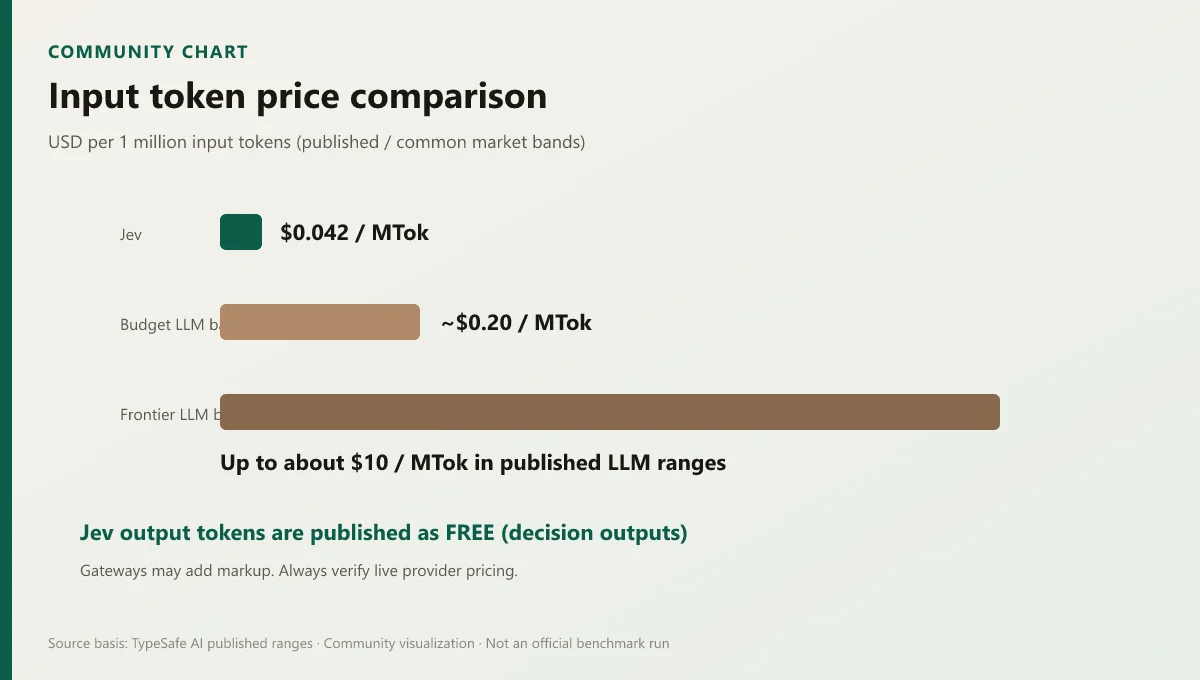
Jev lists about $0.042 / MTok for input and free output tokens. Common LLM bands start higher on input and still charge for generated strings. Gateways may add markup — confirm live rates before budgeting.
Workflow speed & cost headlines
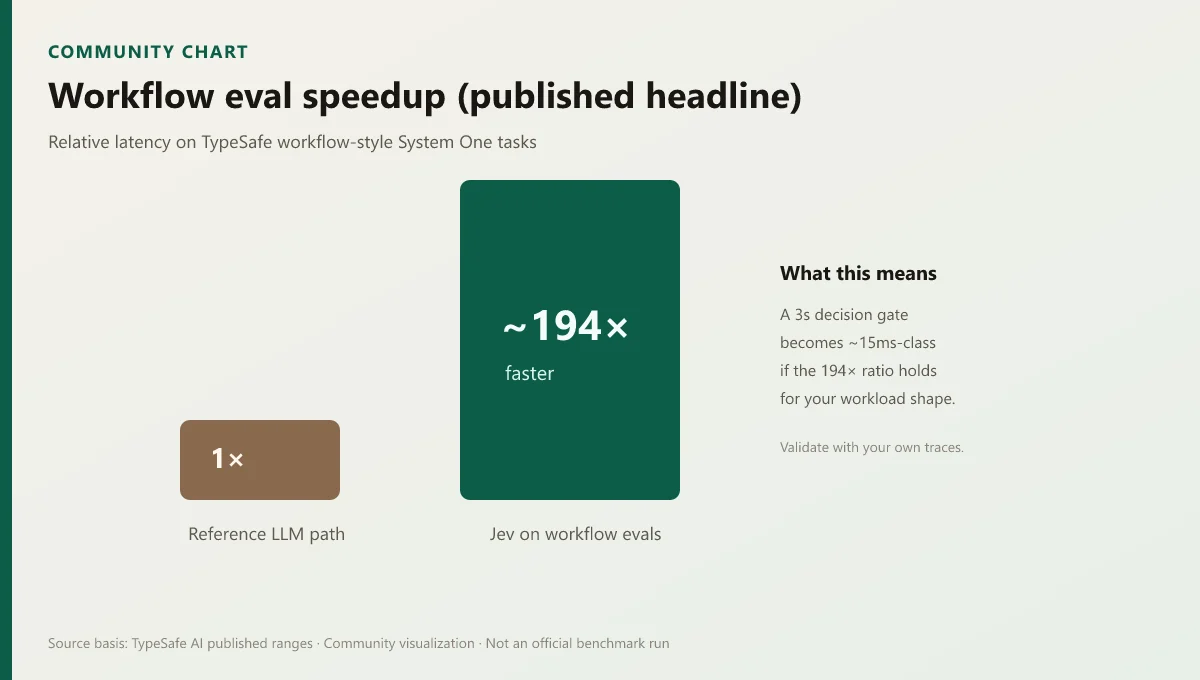
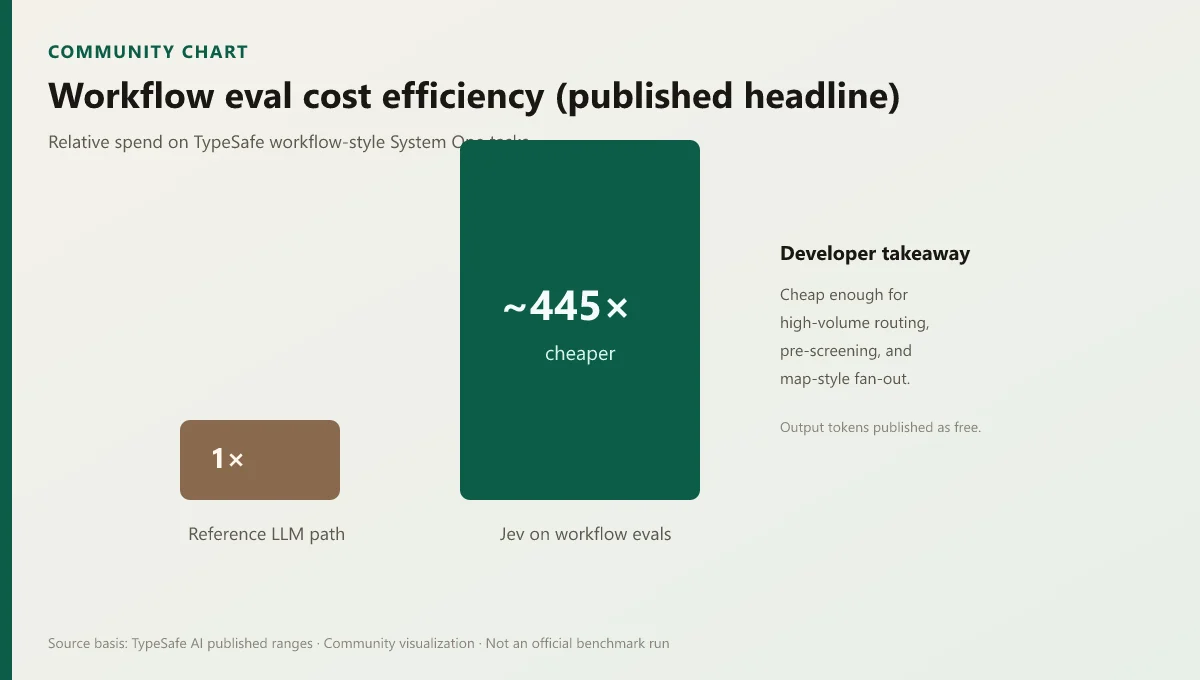
TypeSafe workflow-style evaluations published striking relative numbers versus LLM decision paths. The charts below make those headlines scannable for stakeholders who will not read the full eval write-up.
Public-style test scenarios
These scenarios remix themes from public demos and developer write-ups (routing desks, batch decisions, interactive loops, large Choice sets). They are templates you can turn into your own reproducible fixtures — not copied official lab notebooks.
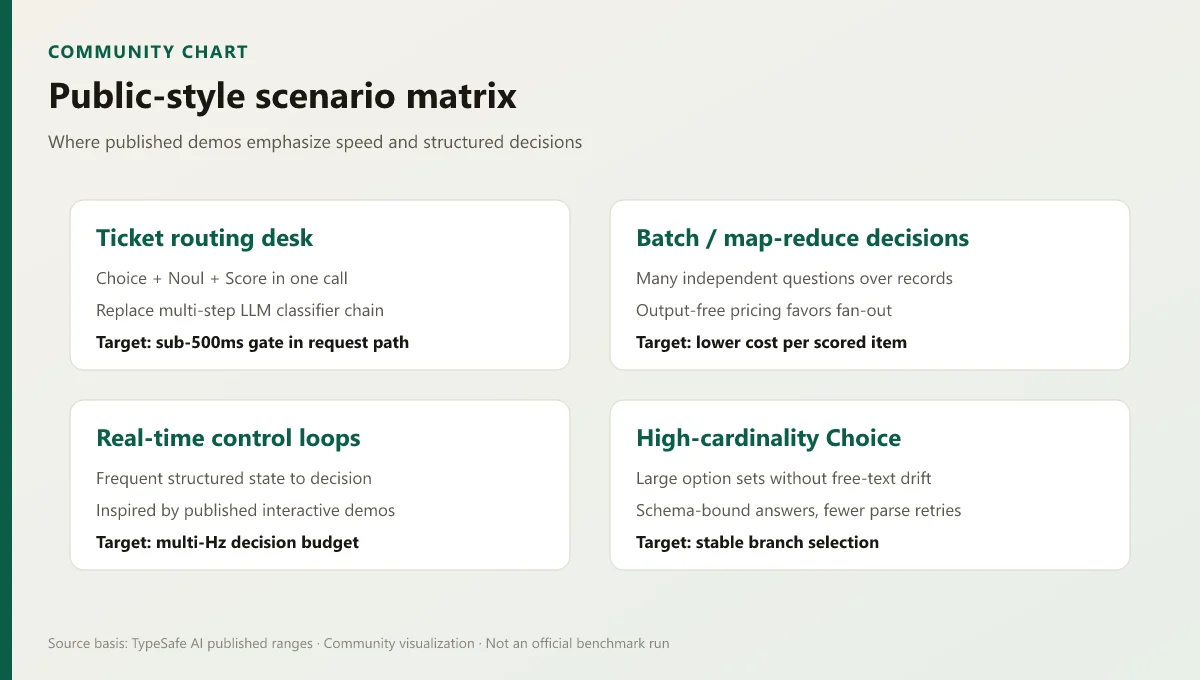
Support ticket triage desk
Send one customer message as state, then ask Choice (team), Noul (urgent?), and Score (frustration) together. This mirrors the public routing demos and replaces a multi-prompt LLM classifier chain.
Expect sub-second decisions when the published latency band holds.
Pre-screen before expensive LLM reasoning
Use Jev to filter low-risk events and only escalate ambiguous cases to GPT/Claude-class models. This is the hybrid pattern that makes the cost charts matter in production.
Most volume stays on cheap decision calls; spend concentrates on hard cases.
Batch map over records
Score or classify many rows with the same question set. Published free output tokens make speculative fan-out far less punishing than generative models that bill for long string responses.
Cost scales mostly with input size, not with verbose answers.
High-cardinality Choice selection
Pass a large option list (teams, SKUs, wiki links style choices). Schema-bound answers avoid free-text hallucination and reduce parser retries that inflate both latency and spend.
Stability gains compound as option count grows.
Back-of-envelope cost table
Rough community estimate using $0.042 / MTok input and free outputs. Assumes ~1,000 input tokens per decision call. Replace with measured token counts from your traces.
| Monthly decisions | Approx. input tokens | Est. Jev input spend |
|---|---|---|
| 100,000 | 100M | ~$4.20 |
| 1,000,000 | 1B | ~$42 |
| 10,000,000 | 10B | ~$420 |
Compare that with generative classifiers that also bill output tokens and often need retries after parse failures. For feature-level differences, see Jev vs traditional LLMs.
Source reference: